
Disconnected supply chains do not break overnight. They erode performance gradually through inefficiency, lack of visibility, and operational friction.
Most supply chains don’t fail because of a single major issue. They fail quietly, over time through fragmentation, misalignment, and a lack of visibility across systems, suppliers, and operations.
On the surface, everything appears to be working. Orders are processed, suppliers are managed, and operations continue as usual. But underneath, many organisations are operating with disconnected systems that don’t communicate effectively.
And that disconnect comes at a cost.
Fragmentation Is the Real Problem
Modern supply chains rely on multiple systems, partners, and data sources. But when these elements are not connected, organisations are forced to rely on manual processes, assumptions, and reactive decision-making.
This creates three core challenges:
- Limited visibility across suppliers and operations
- Inconsistent information across teams and regions
- Delayed response to issues and disruptions
Individually, these may seem manageable. Together, they create structural inefficiency.
The Hidden Cost of Disconnected Supply Chains
The cost of disconnected supply chains is not always reflected in a single line item. Instead, it appears in operational friction and missed opportunities:
- Time lost reconciling information across teams
- Delays in decision-making due to incomplete data
- Inefficiencies in supplier coordination and communication
- Increased exposure to operational and compliance risks
- Reduced agility in responding to market changes
Over time, these inefficiencies compound and limit organisational performance.
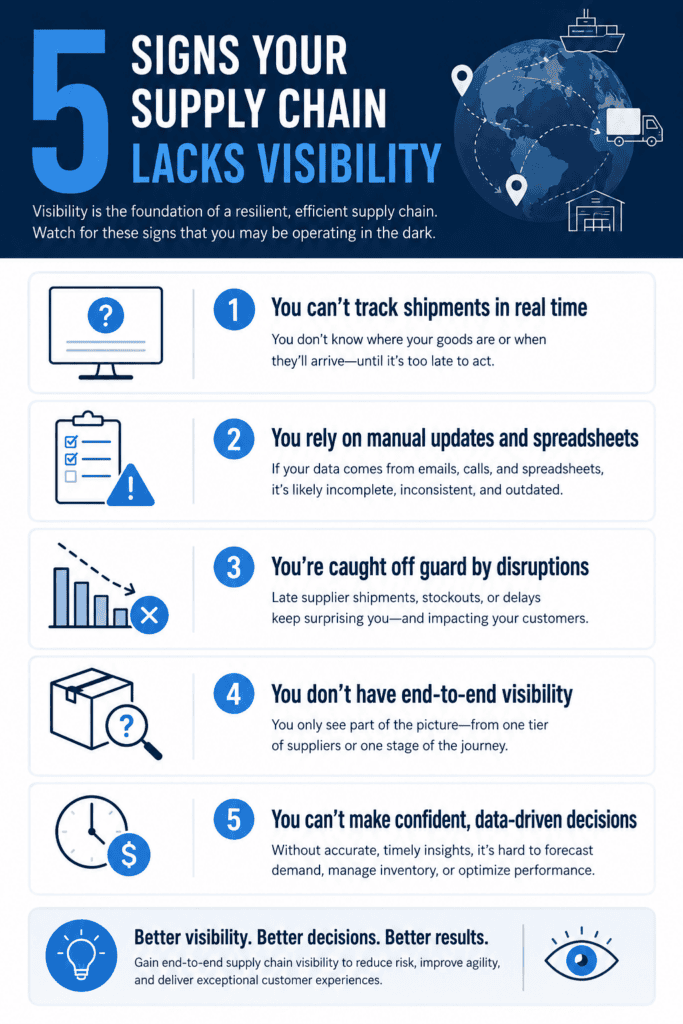
Why Visibility Matters More Than Ever
Supply chains are becoming more complex, global, and fast-moving. At the same time, expectations from customers, regulators, and partners are increasing.
In this environment, visibility is foundational.
Without it, organisations are forced to operate reactively rather than proactively.
With it, they can:
- Anticipate disruptions earlier
- Coordinate suppliers more effectively
- Improve operational decision-making
- Strengthen overall supply chain resilience
From Disconnected Systems to Connected Intelligence
The shift happening across leading organisations is not just digital transformation it is integration.
Instead of managing isolated systems, they are moving toward connected supply chain intelligence, where data, suppliers, and operations work as a unified ecosystem.
This enables:
- Real-time visibility across supply networks
- Faster, more informed decision-making
- Reduced operational friction
- Improved coordination across global suppliers
This is where technology plays a critical role.
Customised Technology as the Enabler
Modern supply chains require more than standard tools. They require tailored systems that reflect the complexity of global operations.
Customised technology solutions help organisations:
- Connect fragmented supply chain processes
- Improve visibility across supplier networks
- Strengthen operational control
- Reduce inefficiencies caused by manual workflows
- Enable scalable, resilient operations
The organisations that will outperform in the next era are those that recognise this early and move from fragmented systems to connected supply chain intelligence.
cleanchaininfo@adec-innovations.com