
Discover what an analysis of 15,000 Safety Data Sheets reveals about chemical data quality and supply chain visibility for textile brands.
For textile and apparel brands, advancing safer chemistry is not simply a matter of adding more substances to restricted lists or introducing more compliance requirements.
It starts with something more fundamental: knowing what chemicals are actually being used across the supply chain and having reliable data about them.
The recently launched Apparel & Footwear Safer Chemistry Profile Baseline Metrics Report, developed by ChemFORWARD with support from the Safer Chemistry Impact Fund and in partnership with representatives from Nike, lululemon, Patagonia and Target, provides important new insights into this challenge.
ADEC Innovations contributed supply chain-relevant data to support the analysis. Through its specialised CleanChain platform, ADEC Innovations works with the apparel, textile and footwear sectors to improve sustainability, support regulatory compliance and enhance supply chain transparency.
The report analysed chemical information disclosed across 15,000 Safety Data Sheets (SDSs) used in apparel and footwear production.
What it reveals should prompt an important question for brands:
How confident are you in the chemical data quality behind your supply chain?
Better chemical management starts with better data
One of the report’s most significant findings is that approximately 4,800 SDS entries contained incorrect CAS numbers or chemical names.
For an individual SDS, an incorrect identifier may appear to be a relatively small data quality issue. Across hundreds or thousands of products, suppliers and manufacturing facilities, however, these inconsistencies can become a much larger operational challenge.
Brands increasingly rely on chemical data quality to understand supplier performance, identify substances of concern, support regulatory requirements and make sustainability decisions.
If the underlying data is incomplete, inconsistent or incorrectly identified, the visibility created from that information may also be compromised. This makes chemical data quality a strategic supply chain issue not simply an administrative one.
Another important conclusion from the research is that disclosure and chemical data quality remain significant constraints.
Nearly 60% of substances included in the analysis were characterised, indicating that hazard information can often be established when the chemical identity itself is known.
For brands, this changes the conversation.
The challenge is not only:
“Do we understand the hazards associated with this chemical?”
It is increasingly:
“Do we know which chemicals are being used, where they are being used and whether the information supplied about them is accurate?”
This is particularly important in complex textile and apparel supply chains, where chemical information may be distributed across multiple suppliers, facilities, countries, systems, SDS documents and spreadsheets.
Without a centralised view, identifying patterns and prioritising action becomes considerably more difficult.
Not every chemical requires the same level of attention. The report also provides an encouraging finding.
Approximately 310 substances accounted for around 80% of the chemical entries identified across the 15,000 SDSs analysed.
For brands managing extensive supplier networks, this demonstrates the potential value of moving from fragmented chemical information towards structured data that can be analysed across the supply chain.
Rather than treating thousands of chemical records as equally significant, better visibility can help organisations understand where chemical use is concentrated and where action could potentially have the greatest impact.
The operational question becomes:
Where should we focus first? Answering that requires more than collecting documents. Brands need chemical information that can be structured, compared and analysed across suppliers and facilities.
How Can Brands Move Beyond Compliance to Proactive Chemical Risk Management?
Chemical management has traditionally been heavily compliance-driven. Restricted Substance Lists (RSLs), Manufacturing Restricted Substances Lists (MRSLs), regulatory requirements and customer standards remain essential components of responsible chemical management.
But the report highlights an opportunity to go further. Identifying chemicals of concern within disclosed supply chain inventories can enable organisations to identify potential risks beyond standard regulations and restricted lists.
For brands, this represents a shift from reactive compliance towards proactive chemical management.
Instead of only asking whether a chemical meets a particular requirement, organisations can begin asking:
- Where is this substance being used across our supplier network?
- Which facilities or products could be affected?
- Are there patterns in chemical use that require further investigation?
- Where are our chemical data gaps?
- Where could safer alternatives be prioritised?
These questions become much easier to address when chemical information is centralised and connected.
What Could Your SDS Data Be Telling You?
Safety Data Sheets remain one of the most important sources of chemical information available to manufacturers and brands. But an SDS sitting in a folder, inbox or supplier database has limited strategic value.
The opportunity is to transform the information contained within SDSs into structured, searchable and usable chemical data. For example, extracting information such as chemical identities, CAS numbers, hazard classifications and H-statements allows organisations to move beyond document storage towards chemical intelligence.
At scale, this can help brands build a clearer picture of chemical use across suppliers and manufacturing facilities.
The objective should therefore not simply be:
“Do we have the SDS?”
It should be:
“Can we use the data within the SDS to make better decisions?”
How Can Reusable Chemical Data Strengthen Industry Collaboration?
Perhaps one of the strongest findings from the report is the value of collaboration.
According to the analysis, 99.9% of identified substances had already been encountered in other sectors within the Chemical Hazard Data Trust managed by ChemFORWARD.
Working Group members collectively invested $45,000 to address 3,026 data gaps, reducing the cost to approximately $14.87 per data gap.
This demonstrates an important principle: chemical information becomes significantly more valuable when it can be structured, shared and reused.
For the apparel and textile sector, greater collaboration between brands, suppliers, technology providers and industry initiatives can help reduce duplication while improving chemical data quality and accessibility of information.
What does this mean for textile and apparel brands? The findings point towards a clear priority.
Safer chemistry depends on better chemical visibility and better visibility depends on better data.
Brands should therefore consider not only the chemical requirements they place on suppliers, but also the infrastructure used to collect, validate, organise and interpret the resulting information.
A more connected approach can help organisations move from:
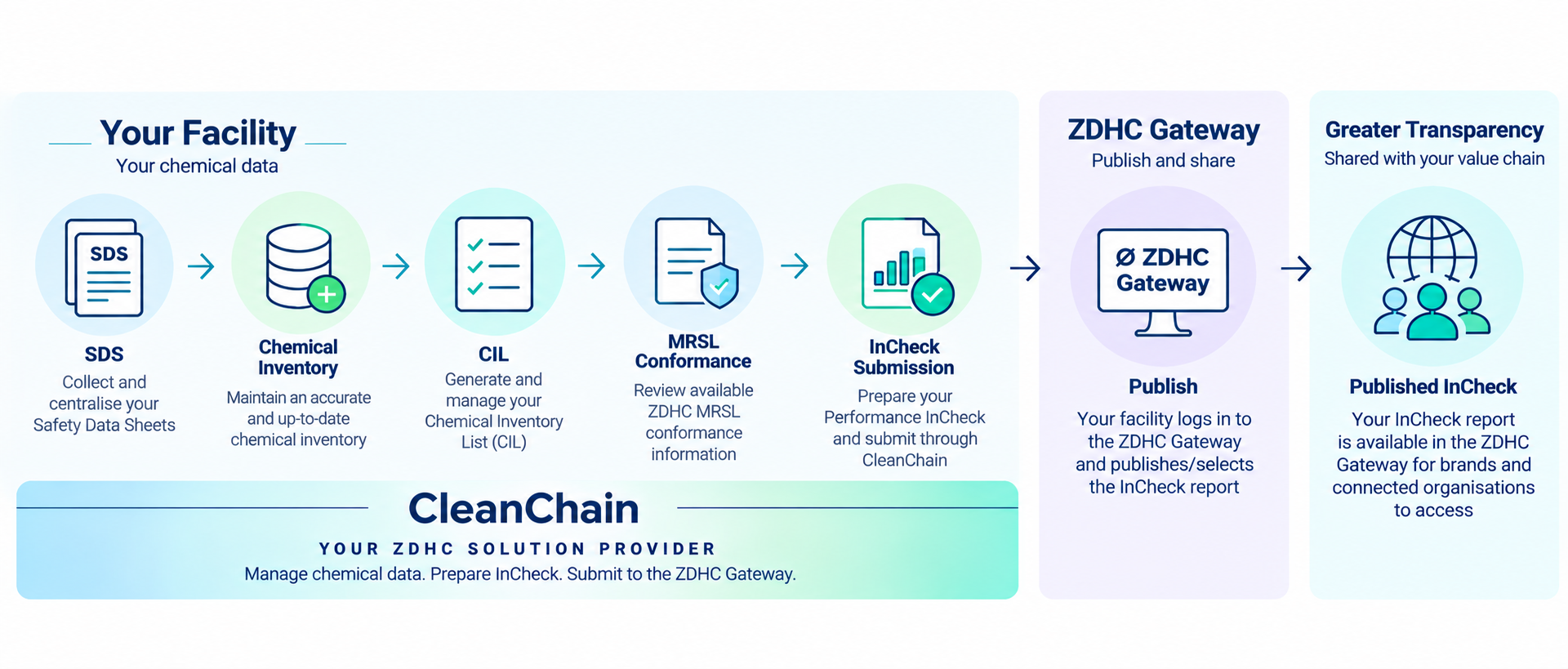
SDS documents → structured chemical data → chemical inventory visibility → risk identification → informed action.
This is where digital chemical management platforms can play an increasingly important role.
Turning chemical data into actionable visibility
CleanChain provides organisations with a connected chemical management and compliance platform designed to centralise chemical inventory, SDS and supplier information.
Its SDS management capabilities use AI-powered data extraction to capture important chemical information, including CAS numbers, hazard classifications and H-statements, helping transform SDS documents into structured and searchable data.
By connecting SDS information with chemical inventory and supplier data, organisations can build greater visibility across complex supplier networks and support more informed compliance and sustainability decisions.
For textile and apparel brands managing chemical programmes across multiple facilities and regions, the goal is not simply to collect more data. It is to make that data accurate, structured and actionable.
The next stage of safer chemistry is data-driven
The analysis of 15,000 SDSs provides a valuable snapshot of where the apparel and footwear industry stands today. It also demonstrates where some of the greatest opportunities lie.
Better disclosure. Better chemical data quality. Greater supply chain visibility. More targeted action. Stronger collaboration.
These are not separate challenges. They are increasingly interconnected. And as brands work towards safer chemistry across increasingly complex global supply chains, one principle is becoming clear:
You cannot manage what you cannot see and you cannot create reliable visibility without reliable data.
How confident are you in your supplier chemical data?
Discover how CleanChain can help centralise SDS, chemical inventory and supplier data to improve chemical visibility across your supply chain.
CTA: Explore CleanChain