Learn how a shared digital platform help industry coalitions streamline data collection, strengthen collaboration, and demonstrate measurable programme impact.
Industry associations and multi-stakeholder initiatives have never played a more important role in driving sustainability, chemical compliance, responsible sourcing, and supply chain transparency. By bringing together brands, suppliers, manufacturers, certifiers, and regulators, these organisations create the frameworks that help entire industries move forward.
Yet while expectations have evolved, the technology supporting many of these programmes has not.
Across industries, associations continue to manage member engagement, supplier information, programme reporting, and compliance activities through a patchwork of spreadsheets, emails, shared folders, and standalone applications. While these methods may have been sufficient when programmes were smaller, they become increasingly difficult to manage as participation grows and reporting requirements become more complex.
The result is often the same: more administration, inconsistent data, limited visibility, and less time to focus on delivering meaningful value to members.
The Hidden Cost of Fragmented Data
Every coalition depends on data.
The challenge is not simply collecting information it’s managing it consistently across an expanding network of organisations. Gartner research found that among organisations required to comply with the EU Corporate Sustainability Reporting Directive (CSRD), only one in four surveyed organisations had a dedicated reporting platform, despite most already being subject to the regulation.
Whether measuring chemical compliance, monitoring sustainability performance, tracking supplier engagement, or reporting against programme objectives, accurate and consistent information is fundamental to demonstrating impact.
However, when data is collected through disconnected processes, organisations often face familiar challenges:
- Multiple versions of the same spreadsheet
- Manual consolidation of member submissions
- Inconsistent reporting formats
- Duplicate requests for information
- Limited visibility across participating organisations
- Time-consuming reporting cycles
These inefficiencies affect more than internal operations. They also create additional work for members and suppliers, who are frequently asked to provide the same information in different formats for different programmes.
As regulatory expectations increase and supply chains become more interconnected, these manual processes become increasingly difficult to sustain.
From Programme Management to Digital Collaboration
Leading industry initiatives are moving beyond simply coordinating programmes. They are creating shared digital platforms that enable collaboration across their entire network.
Instead of collecting data once a year through spreadsheets, members can securely submit information through a shared digital platform. Suppliers can provide information once and reuse it across multiple requests. Programme administrators gain immediate visibility into participation, compliance status, and emerging risks.
Rather than spending valuable time compiling reports, organisations can focus on analysing trends, identifying opportunities for improvement, and supporting members with meaningful insights.
Technology becomes an enabler of collaboration rather than another administrative burden.
A Platform Designed Around the Ecosystem
No two industry initiatives operate in exactly the same way.
Each coalition has its own governance model, reporting framework, member structure, and programme objectives. Technology should adapt to those requirements, not force organisations into predefined workflows.
A configurable shared digital platform allows associations to build processes that reflect the way their programmes operate while providing members with a consistent and intuitive experience.
This can include:
- Member onboarding and management
- Supplier collaboration
- Standardised data collection
- Automated workflows and notifications
- Dashboards for programme performance
- Secure document management
- Benchmarking across participating organisations
- AI-powered analytics and reporting
By centralising these activities, organisations establish a single source of trusted information that supports both operational efficiency and long-term programme growth.
Turning Data Into Action
Collecting data is only part of the equation.
The greater opportunity lies in transforming that information into actionable intelligence.
Artificial intelligence is changing how organisations interpret large volumes of sustainability and compliance data. Instead of manually reviewing reports or identifying trends, programme managers can quickly understand where engagement is increasing, where risks are emerging, and where additional support may be required.
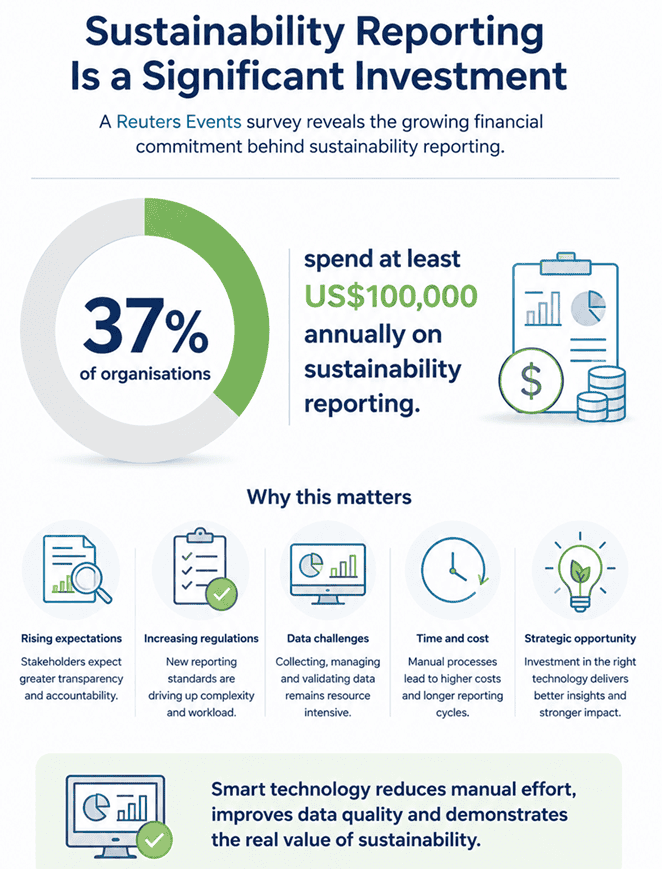
A Reuters Events survey found that organisations are increasingly planning investments in ESG data management platforms, AI for materiality assessments, and sustainability risk management solutions as reporting requirements become more demanding. The survey also found that 37% of organisations spend at least US$100,000 annually on sustainability reporting, highlighting the growing importance of digital solutions that reduce manual effort and improve data quality.
AI can also automate repetitive administrative tasks, reducing the burden on programme teams while improving the quality and consistency of reporting.
For industry coalitions managing hundreds of participating organisations, these efficiencies can significantly improve both programme delivery and member experience.
Shared Digital Platform Delivering Greater Value to Members
Members increasingly expect more than access to guidance documents or annual reports.
They want practical tools that simplify reporting, improve collaboration, and provide clear visibility into their own performance.
A shared digital platform helps associations deliver that value by enabling members to:
- Submit information once and reuse it where appropriate
- Monitor their own progress through real-time dashboards
- Collaborate more effectively with suppliers and partners
- Respond more efficiently to evolving regulatory requirements
- Benchmark performance against programme objectives
- Identify opportunities for continuous improvement
When technology removes unnecessary complexity, members can spend less time managing data and more time improving performance.
Preparing for the Next Generation of Industry Collaboration
Global sustainability expectations continue to evolve. Regulations are becoming more demanding, supply chain transparency is increasing, and stakeholders expect measurable evidence of progress.
For industry associations and coalitions, this represents both a challenge and an opportunity.
Those that invest in a shared digital platform will be better positioned to support members, demonstrate programme impact, and scale their initiatives without proportionally increasing administrative effort.
The future of industry collaboration is not built on more spreadsheets or disconnected systems. It is built on trusted data, intelligent automation, and digital platforms that connect every participant across the value chain.
At CleanChain, we believe technology should strengthen collaboration, simplify compliance, and enable organisations to turn data into measurable action. By designing AI-powered platforms around the unique needs of each ecosystem, we help industry initiatives create greater value for their members while driving transparency, accountability, and continuous improvement across global supply chains. cleanchaininfo@adec-innovations.com